
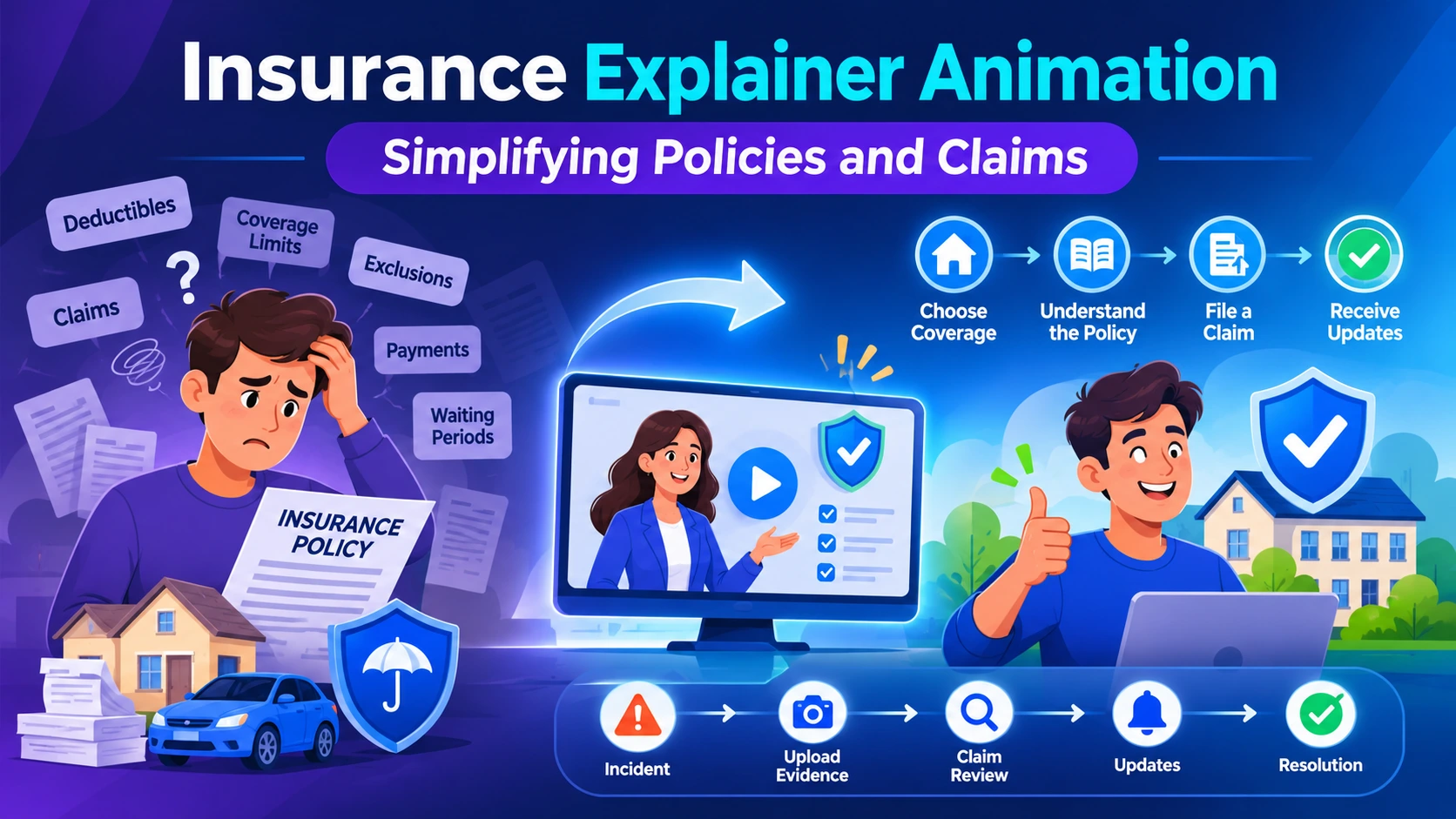
Five questions every policyholder asks, and how to answer them before they call.
Insurance is a product people buy hoping never to use, priced on events they’d rather not think about, and described in a contract few of them will read. Then, on the worst day of their year, they need to understand it perfectly. That gap between purchase and claim is where most complaints, cancellations, and call-center costs come from. An insurance explainer animation narrows it by showing how coverage works in moments, before the policyholder is standing in a flooded kitchen trying to remember what “actual cash value” means.
Following the Policyholder Through Five Questions
Every policyholder moves through the same sequence, and each stage raises a question in plain language. Insurance explainer videos work best when they answer those questions at the stage where they’re asked, instead of front-loading everything into one sales video.
“What Do I Need?”
Shoppers need help understanding the type and amount of cover that fits their situation. Animation can compare options side by side: term against whole life, liability-only against comprehensive auto, a renters policy against relying on a landlord’s cover. Showing a household’s real exposures, such as a mortgage, a car loan, or children’s education, makes “how much” feel concrete instead of arbitrary.
“What Am I Signing?”
At the point of purchase, the goal is informed consent. Short videos explaining the key terms of the specific policy, including the deductible, the limits, and the main exclusions, help buyers commit with confidence. They also reduce cancellations during the free-look period and disputes later, because the customer saw the boundaries of cover before paying.
“What’s Covered Now?”
Most policyholders forget their cover within months. A welcome video sent after purchase, and a reminder before seasonal risks such as hurricane season or winter driving, keep the policy present in their mind. Insurance education videos at this stage also encourage risk-reducing behavior, from installing leak detectors to taking defensive driving courses, which benefits the insurer’s loss ratio.
“What Happens Now That Something’s Gone Wrong?”
The claim is the moment of truth, covered in more detail below. Policyholders want to know what to do first, what evidence to gather, how long each step takes, and when they’ll be paid.
“Why Did My Premium Change?”
Renewal is where many customers leave, often because a premium rose without a clear reason. An animated explanation of rating factors, such as rebuild costs, regional claims trends, reinsurance costs, or a change in the driver profile, won’t make an increase welcome. It does make it understandable, and understood increases are far less likely to trigger a switch.
Introduce Your Script
To The World With Our
Explainer Videos

The Concepts That Animate Best
Some insurance terms are hard to explain in words and easy to show in motion. These are the ones carriers ask about most often.
| Concept | Why it confuses people | What animation can show |
| Deductible | People confuse it with the premium | A claim bill, with the policyholder’s share paid first and the insurer covering the rest |
| Coinsurance | Percentages after a deductible are hard to picture | A cost bar splitting between policyholder and insurer as the bill grows |
| Exclusions | Buried in long clauses | The same event shown twice, covered in one version and excluded in the other, with the reason |
| Actual cash value vs replacement cost | Depreciation is abstract | A five-year-old roof valued both ways, with the difference made visible |
| Liability limits | Large numbers feel meaningless | A lawsuit amount exceeding the limit, and who pays the gap |
| Waiting and elimination periods | Timing rules are easy to miss | A calendar showing when cover begins and when payments start |
| Cash value in permanent life | Two products in one policy | Premiums splitting between protection and a growing savings component |
Animated insurance videos built around a single concept, each 30 to 60 seconds long, can be embedded beside the relevant line on a quote page, in policy documents, and in help centers. Animation for insurance companies works especially well in this modular form, because one concept video can serve every product line that uses the term.
Agents, Brokers, and Employers Need Their Own Versions
Insurance rarely reaches customers directly. Much of it goes through intermediaries, and each one needs different material.
Independent agents and brokers represent several carriers, and they recommend the products they can explain easily. A carrier that hands agents short, clear insurance animation videos for each product makes those products easier to sell. The same videos work in agent onboarding and continuing education, alongside other forms of animated training videos.
Employee benefits are another major channel. During open enrollment, employees choose between health plans, life coverage, and disability benefits in a short window, often with little help. Insurance education videos explaining plan differences, HSAs, and supplemental coverage reduce wrong choices and the HR questions that follow. Health insurers and benefits platforms can see related work on our healthcare animation page.
Embedded insurance, sold at checkout alongside a flight, a phone, or a rental car, has seconds to explain itself. A five- to ten-second animation showing what’s covered can lift take-up without slowing the purchase.
Getting Through Legal and Compliance Review
Insurance advertising is regulated. In the US, state insurance departments oversee it, and many states base their rules on NAIC model regulations governing advertisements for life, accident, and health insurance. The principles are consistent across markets: claims must be accurate, limitations must not be hidden, and coverage must not be overstated.
For video, that means a few practical habits. Show exclusions and limits honestly when the story touches them. Use phrases such as “subject to policy terms and conditions” where required, and keep them on screen long enough to read. Avoid absolute language like “fully covered” or “nothing to worry about.” Make sure product names, state availability, and any figures match current filings. And involve compliance at the script and storyboard stage, when changes cost little, instead of after the animation is finished.
Animation helps here more than live action does. Updating a disclaimer, a premium example, or a state-specific detail in an animated scene is quick, while reshooting a live-action spot is not. Many insurers keep a master video and produce state or product variants from the same files.
Commercial Lines Need a Different Voice
Personal lines speak to households. Commercial insurance speaks to business owners, finance directors, and risk managers, and the explanation has to change accordingly.
A small business owner buying a business owner’s policy, workers’ compensation, or cyber cover usually has limited time and limited insurance knowledge. They want to know what could hurt the business, what the policy pays for, and what it costs, in that order. Short insurance explainer videos built around realistic scenarios, such as a customer slipping in a shop, a ransomware attack locking the booking system, or an employee injured on site, make abstract cover concrete.
Cyber insurance deserves special mention. It’s one of the fastest-growing commercial lines, and also one of the most misunderstood, because policies combine first-party cover such as incident response and business interruption with third-party liability and often require specific security controls before binding. Animation can show both halves of the cover and the controls an insurer expects, such as multi-factor authentication and offline backups, in a way a policy wording never will.
Larger commercial buyers and their brokers need more depth: how layered programs work, how captives fit in, what a reinsurance tower looks like. Insurance animation videos for this audience can run longer and use cleaner, more technical motion graphics. Animation for insurance companies in the commercial space also supports underwriters and broker partners, who need to explain the same structures to their own clients. Our finance animation page shows how we approach financial structures for professional audiences.
Measuring What Changes
The value of insurance explainer animation shows up most clearly in operational numbers. On quote pages, track quote-to-bind rate and abandonment at the coverage selection step. After purchase, watch free-look cancellations and early policy changes, which often signal that the customer didn’t understand what they bought. In claims, measure inbound call volume per claim, time to complete first notice of loss, and the share of customers using digital tools. At renewal, compare retention for customers who received a premium explanation video against those who didn’t.
Start with one or two placements and a clean baseline. A claims guide and a deductible explainer are usually the easiest to measure, because their effect on calls and complaints is direct. Once the results are in, the case for a wider library of animated insurance videos, including insurance education videos for onboarding and renewal, becomes much easier to make internally. Insurance explainer animation that’s measured this way tends to win budget from operations as well as marketing, since it reduces costs as well as supporting sales.
What Usually Goes Wrong?
The most persistent problem in insurance marketing is fear. Videos that open on house fires, car crashes, and grieving families get attention, then leave viewers anxious and less inclined to engage. Calm, practical explanations of how protection works tend to perform better and fit the reassurance customers want from an insurer.
Another is the company-centered video: a tour of the insurer’s history, financial strength rating, and headquarters, with very little about what the customer gets. Ratings matter, but they work best as proof inside a customer-centered story.
The third is the generic catch-all video expected to serve every product line and every audience. Auto, home, life, and commercial lines have different buyers, different fears, and different vocabulary. A modular library of short animated insurance videos, organized by product and lifecycle stage, almost always outperforms one long brand film.
Designing for Every Policyholder
Insurance customers span every age group, language, and level of digital confidence, and the people filing claims are often older or under stress. Captions should be on by default, narration should be unhurried, and on-screen text should be large enough to read on a phone. In the US, Spanish-language versions reach a large share of policyholders who are often underserved by English-only materials. Animation for insurance companies makes this practical, since voiceover and text layers can be replaced for each language while the visuals stay the same.
Accessibility also supports regulatory goals. Clear, captioned insurance explainer animation helps demonstrate that policy terms were communicated fairly, which matters if a dispute ever reaches a regulator or a court.
Choosing a Production Partner
Look for a studio with financial services or insurance experience, a clear process for compliance review, and the ability to deliver modular content at scale. Ask how they handle state variants and updates, and confirm they can produce versions for agents, employers, and direct customers from the same assets. Whiteboard and simple 2D styles are popular in insurance because they feel calm and educational; our whiteboard animation services are a common choice for policy explainers.
Our insurance animation video services cover carriers, MGAs, brokers, and insurtechs, from single concept videos to full lifecycle libraries. For broader explainer work, including brand-level product launches, see our insurance explainer video services and the range of styles they include.
Start With the Claim
If you can fund only one video this year, make it the claims guide. It reaches customers at the moment that decides renewal, it cuts calls during your busiest weeks, and it shows every policyholder what your promise looks like in practice. Pixel Studios Inc. produces insurance explainer animations for every stage after that, from quote pages to renewal notices.
Share your current claims process with us, even if it’s only a PDF, and we’ll show you where a short video would remove the most confusion.
Introduce Your Script
To The World With Our
Explainer Videos
Frequently Asked Question?
What is insurance explainer animation?
Insurance explainer animation is a short animated video that explains how insurance products, policy terms, and claims processes work. Carriers, brokers, and insurtechs use it on quote pages, in policy documents, during onboarding, in claims communications, and for agent training to make coverage easier to understand.
Which insurance concepts are easiest to explain with animation?
Deductibles, coinsurance, exclusions, actual cash value versus replacement cost, liability limits, waiting periods, and cash value in permanent life insurance all animate well. These concepts involve money splitting, time passing, or values changing, which motion shows far more clearly than written policy language.
How can animation improve the insurance claims experience?
Animated claims guides show customers what to do first, what evidence to collect, how to submit it digitally, and what happens at each stage. Clear expectations reduce status calls and complaints, and they help customers use digital claims tools, which J.D. Power’s 2026 study linked to higher satisfaction.
Do insurance explainer videos need regulatory approval?
Insurance advertising is regulated, typically by state insurance departments in the US and by financial regulators elsewhere. Requirements vary, but videos should accurately describe coverage, disclose key limitations, and avoid overstated claims. Involve compliance early, and confirm with each state’s rules if filing or prior approval is required.
How long should insurance animation videos be?
Concept videos explaining one term work best at 30 to 60 seconds. Product overviews usually run 60 to 120 seconds, and claims guides one to two minutes. Embedded insurance offers at checkout need even shorter clips, often five to ten seconds.

