
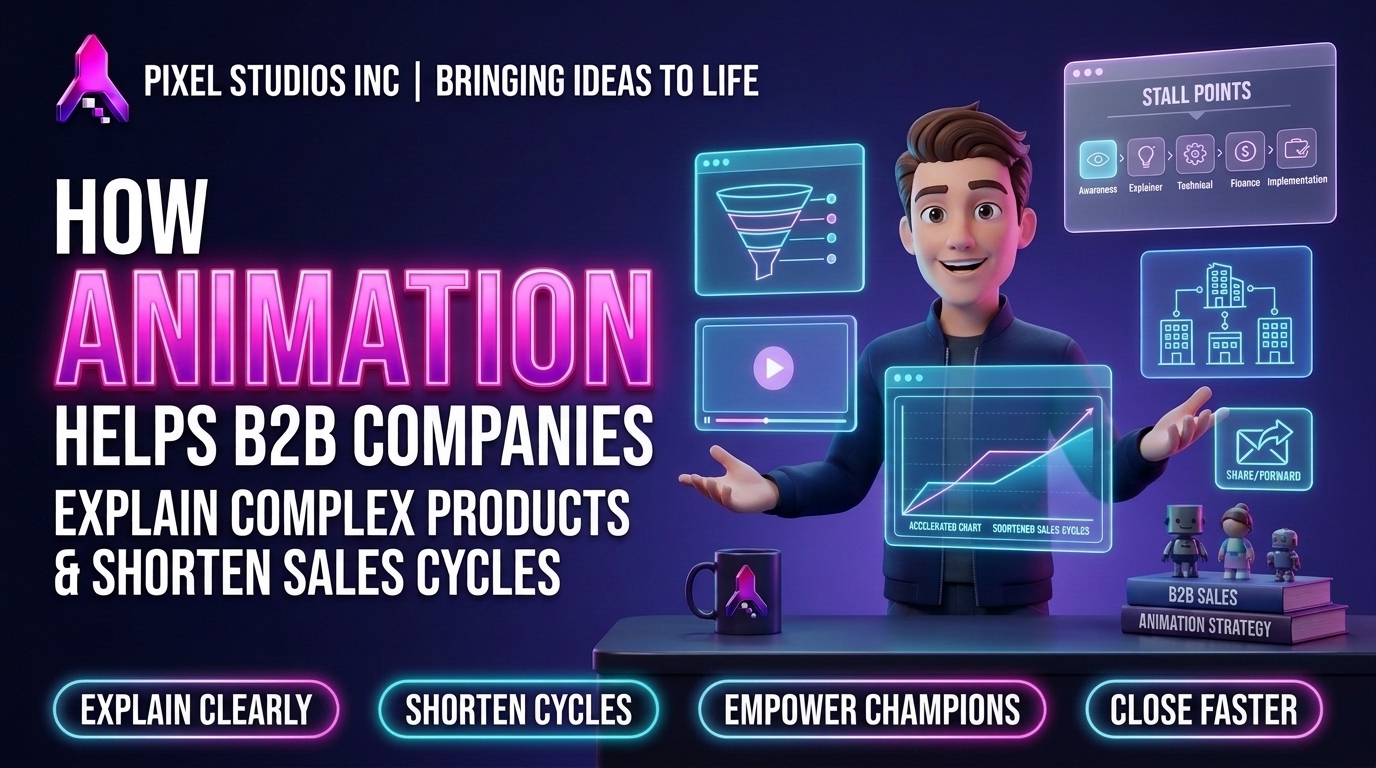
Your champion has to sell your product in meetings you might never attend. Give them something to press play on.
Long B2B sales cycles often have a quieter cause than anyone puts in the CRM: explanation decay. Your rep explains the product well to one person, that person explains it less well to three colleagues, and by the time it reaches the CFO it has become “some kind of platform that does integrations.” Every retelling loses detail and confidence, and the deal slows down. Product animation fixes the retelling problem by giving every stakeholder the same clear explanation, in the same words, no matter who forwards it.
The Problem Is the Second Conversation
Sales teams obsess over the first meeting. The pitch deck gets rewritten every quarter. The demo environment gets polished. Reps rehearse objection handling.
Then the champion walks out of that meeting and has to sell the product internally, without slides, without the rep, and usually without a deep understanding of how it works. They are now your most important salesperson, and they’ve had forty-five minutes of training.
This is where complex products suffer most. A manufacturing execution system, a cloud security platform, an industrial sensor network, or a payments infrastructure product can’t be summarized in a hallway conversation. When the champion can’t explain it clearly, the buying group hesitates, asks for another meeting, requests a second demo for a different team, or quietly moves on to the vendor whose story was easier to repeat.
Animation is unusually good at this problem because it travels. A 90-second video can be forwarded, embedded in an internal email, dropped into a Teams channel, or played at the start of a budget meeting. It explains the product exactly the same way every time.
Introduce Your Script
To The World With Our
Explainer Videos

Where Deals Stall, and What Animation Does About It
Every complex B2B sale moves through a few predictable choke points. Each one calls for a different kind of video.
Stall Point One: The Problem Isn’t Recognized Yet
Early in the cycle, many buyers don’t see the cost of their current approach. Spreadsheets work well enough. The legacy system is annoying but familiar. A short animated piece that shows the hidden cost of the status quo, such as manual rework, downtime, or compliance exposure, creates urgency without a hard sell. This is awareness work, and it suits stylized 2D animation that can show processes and consequences in a simplified way.
Stall Point Two: The Champion Can’t Re-Explain It
This is the stall point described above, and it’s the one where a well-made explainer pays for itself fastest. The video should cover what the product does, who it’s for, what changes after adoption, and why this vendor is the safe choice. It should be short enough to watch in a meeting and clear enough that a finance director understands it on the first viewing. Our comparison of an explainer video vs. a product demo covers how this asset differs from the technical walkthrough that comes later.
Stall Point Three: Technical Validation
Engineers, IT architects, and operations leads want to see how the product works inside. This is where 3D earns its place. Exploded views show how components fit together, cutaways show flow through a system, and animated architecture diagrams show how software connects to existing infrastructure. Technical reviewers trust what they can inspect, and animation lets them inspect things no camera can reach. Our guide to exploded view animation explains why that single shot is so persuasive for engineering audiences.
Stall Point Four: Finance and Procurement
Finance cares about three things: what it costs, what it saves, and what happens if it fails. A short animated business case, showing the before and after in time, labor, risk, or capacity, gives the economic buyer something concrete. Keep it under a minute and avoid technical detail entirely.
Stall Point Five: Implementation Fear
Late in the cycle, buyers worry about the switch. How long will rollout take? What disruption will the team face? Who does what? An animated implementation overview, showing phases, responsibilities, and timeline, reduces the fear that kills deals at the finish line. It also sets expectations that make onboarding smoother after signature.
Five Videos, One System
Read the stall points again, and a pattern appears. A complex B2B product doesn’t need one video. It needs a small set, each matched to a moment in the cycle:
| Stall point | Video | Typical viewer | Style that fits |
| Problem not recognized | Status quo story | Line-of-business leader | 2D, stylized, story-led |
| Champion can’t re-explain | Core explainer | Whole buying group | 2D with simplified product visuals |
| Technical validation | Technical walkthrough | Engineers, IT, operations | 3D or UI animation, detailed |
| Finance and procurement | Business case | CFO, procurement | Motion graphics with data |
| Implementation fear | Rollout overview | Project leads, end users | 2D, process-focused |
Built together, these share characters, colors, product models, and design language. That shared system is what makes the set affordable, because the second and third videos reuse most of the assets created for the first. It also makes the company look coherent, which in a high-value purchase is a trust signal of its own.
2D or 3D? Let the Product Decide
Taste often decides the choice between 2D and 3D. The product itself is a much better guide.
Physical products with internal mechanics, such as machinery, medical devices, sensors, vehicles, and electronics, almost always benefit from 3D. Buyers need to see form, scale, materials, and how parts move. CAD data usually exists already, which makes accurate models faster to build. For manufacturers, our 3D industrial animation and 3D product animation work shows the level of engineering detail that technical buyers expect.
Software, services, and processes usually suit 2D. The product has no physical form, so the job is to make abstract ideas visible: data moving, teams collaborating, risk being reduced. 2D handles abstraction cleanly, costs less to update when the product changes, and keeps the focus on outcomes.
Many B2B products sit in between. An IoT platform has hardware and software. A logistics system has warehouses and dashboards. In those cases, 2D and 3D animation videos work well together: a 3D model of the device or facility, with 2D overlays for data and workflows. Our 2D vs 3D animation comparison goes deeper on cost, timeline, and fit.
Budget follows the same logic. 3D animation services carry higher upfront costs for modeling, materials, and rendering, but the model becomes a reusable asset for every future video, configurator, and trade show screen. 2D animation services cost less to start and less to update, which suits software that changes every quarter. A hybrid program usually builds the 3D model once and spends most of its ongoing budget on 2D updates around it, a split that keeps quality high without rebuilding expensive assets each time the messaging changes. When you brief a studio on 3D animation services, ask them to price the model and the first film separately, so you can see what you’ll own afterward.
What Buyers in Different Industries Need to See
The stall points are universal. What fills them changes by sector.
Manufacturing and industrial buyers want to see the product running inside a real process: throughput, uptime, maintenance access, and how it connects to the line around it. Engineering accuracy matters more than polish, and 3D built from CAD data is usually the right call. Our manufacturing animation work shows the level of detail plant and operations teams expect.
Enterprise software buyers want to see integration, security, and governance before features. IT teams ask how the product fits the existing stack, who can access what, and how data moves. Clean 2D architecture animation, paired with simplified product UI, answers those questions without a three-hour technical call. The enterprise animation page covers how large organizations use these assets across regions and business units.
Technology hardware, such as sensors, networking equipment, and connected devices, sits between the two. Buyers want the physical device and the data it produces in the same story, which is where 2D and 3D animation videos combine well: a 3D model of the hardware, with 2D overlays showing dashboards, alerts, and the decisions they support.
Professional services and platforms with no physical product face the hardest explanation challenge of all, because there is nothing to film. Product animation can show the process a client goes through, the handoffs between teams, and the result at the end, giving an intangible offer a visible shape.
Getting the Videos Into the Sales Process
A video library helps only if reps use it at the right moment. That takes a little operational work.
Store every version in the place reps already work: the CRM, a sales enablement platform, or a shared drive with clear naming. Label each video by stall point and audience, so a rep preparing for a procurement call can find the business case in seconds. Embed the core explainer in the first follow-up email template and the technical walkthrough in the template sent after discovery. If you use digital sales rooms, add the relevant videos to each room so the champion can share them internally with one link.
Train the team on when to send what. A short internal session, walking through the five stall points and the matching video for each, usually does more for adoption than any amount of marketing announcement. Ask reps which questions still come up repeatedly after the videos are in use. Those questions point to the next video worth making.
Events deserve their own versions. Trade show screens need silent loops with large text, and webinar openings need a short, energetic cut that sets context before the speaker starts. The same 2D animation services and 3D models used for the sales set can produce these cuts quickly.
What Good B2B Product Animation Gets Right
Strong B2B videos share a few habits that weaker ones skip.
- They start with the buyer’s problem in the buyer’s language. A procurement director at a hospital system and a plant manager at a food processor describe the same pain very differently. Writing for one specific audience beats writing for “decision-makers.”
- They show the product in context. A component floating in a white void tells an engineer very little. The same component installed in a line, connected to the systems around it, shows how it fits into their world.
- They make proof visible. Certifications, uptime figures, integration partners, case study results, and customer logos you’re cleared to use belong in the video, positioned as evidence instead of decoration.
- They respect the viewer’s time. Ninety seconds that answer the right questions beat four minutes that answer every question. Depth belongs in follow-up assets.
- And they’re built for forwarding. That means captions for silent viewing, a clear title, a thumbnail that explains the topic, and a version short enough to play at the top of an internal meeting.
The Mistakes That Keep Deals Slow
The most common one is building a single long video to serve every stakeholder. It’s too technical for finance, too shallow for engineering, and too long for anyone to forward. Splitting it into focused pieces almost always works better, and it rarely costs more once the assets are shared.
Another is letting the product team write the story. Engineers and product managers know every capability, and their first drafts usually list all of them. Buyers need three outcomes and a reason to trust you. Start from sales call notes and lost-deal reviews, then bring product experts in to check accuracy.
The third is treating the video as a marketing asset only. B2B product animation does some of its best work inside the sales process: in follow-up emails, proposal documents, procurement portals, and onboarding plans. If the sales team doesn’t know the video exists, or can’t find the right version quickly, most of its value is lost. Put the videos where reps work, and train them on when to send each one.
Measuring the Effect on the Sales Cycle
Sales cycle impact is measurable if you plan for it. Track which opportunities received each video and compare them against similar deals that didn’t. Useful measures include time from first meeting to proposal, number of meetings per closed deal, win rate at the technical validation stage, and the share of deals that stall at procurement. Engagement data from video hosting tools shows who watched, how much, and how many times a link was shared inside the buyer’s organization. A video forwarded to five new contacts is doing exactly the job it was built for.
Give it a full quarter before judging. B2B cycles are long, and early results can mislead in both directions.
Choosing the Right Partner
Look for a studio that can work in both 2D and 3D, understands B2B buying, and will ask about your sales process before it asks about visual style. Our 2D animation services and 3D animation services are often combined for exactly this reason, so a single team can build the explainer, the technical walkthrough, and the business case in one consistent style.
Ask any studio you’re considering to show B2B work tied to a sales outcome, and how they worked with the client’s sales team to place it. Ask who writes the story, and how they turn engineering detail into buyer language. Our guide on how to choose an animation company lists more questions to ask before you commit.
Give Your Champion a Better Story
Somewhere inside your next big account, a champion is trying to explain your product to a room you’ll never see. Pixel Studios Inc. builds product animation that does that explaining for them, clearly and consistently, from the first awareness video to the rollout plan.
Tell us where your deals usually stall, and we’ll recommend the first video to build.
Introduce Your Script
To The World With Our
Explainer Videos
Frequently Asked Question?
What is product animation in B2B marketing?
Product animation in B2B marketing is the use of 2D or 3D animated video to explain how a product works, what problem it solves, and why it is a safe choice for a business buyer. It is used across the sales cycle, from awareness content and explainers to technical walkthroughs, business cases, and implementation overviews.
How does animation shorten B2B sales cycles?
Animation gives every member of a buying group the same clear explanation, even when the sales rep isn’t present. That reduces repeat meetings, helps champions sell internally, and answers technical, financial, and implementation questions earlier, which removes common reasons deals stall.
Should B2B companies use 2D or 3D animation?
Choose based on the product. Physical products with internal mechanics usually benefit from 3D, which shows form, materials, and moving parts. Software, services, and processes usually suit 2D. Products with both hardware and software often combine 3D models with 2D overlays.
How many videos does a complex B2B product need?
Most complex products benefit from three to five focused videos: a core explainer, a technical walkthrough, a short business case, and an implementation overview, with an optional awareness piece. Sharing characters, models, and design across the set keeps costs down and the brand consistent.
What makes 2D and 3D animation videos effective for technical buyers?
Accuracy, context, and visible proof. Technical buyers trust models built from real CAD or product data, shown working inside a realistic environment, with certifications, performance data, and integration details presented clearly. Exaggerated claims or vague visuals lose them quickly.

