
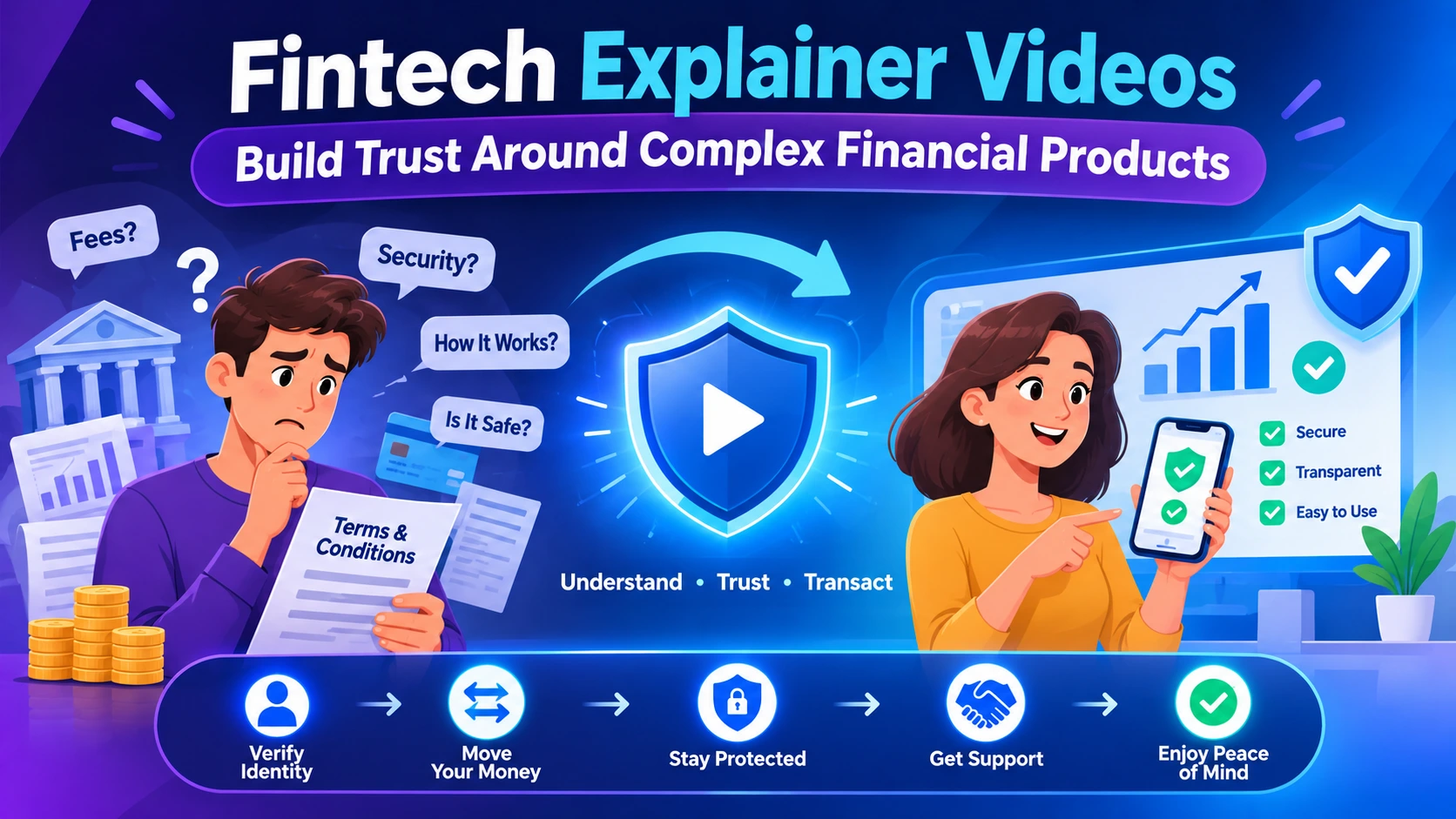
For the companies asking people to trust an app with their money.
Banks spent a century earning trust with marble floors, vault doors, and branch managers who knew customers by name. A fintech gets a phone screen and a few seconds of attention. That screen has to explain a product most people find intimidating, prove the money is safe, and do it without the reassurance of a building. Fintech explainer videos have become one of the most effective ways to close that gap, provided they explain instead of hype. Here’s where trust breaks down, and how animation rebuilds it.
The Trust Gap, in Numbers
Fintechs start behind. In a February 2026 Morning Consult survey for the American Bankers Association, 45% of US adults named banks as the institution they trust most to protect them from fraud. Non-bank fintech providers such as PayPal, Venmo, and Apple Pay were named by 9%. The survey was commissioned by a bank trade group, which is worth keeping in mind, but the direction matches independent research.
Attest’s 2026 consumer data shows the same pattern in the UK: 77% of consumers trust traditional banks, compared with 54% for neobanks. The same research found that 39% of people rank trust as the most important factor when choosing a financial product, well ahead of the 18% who put low fees first. And 87% of 25- to 34-year-olds expect firms to help them understand investment products.
Put those numbers together, and the job becomes clear. Cheaper and faster are not enough on their own. A fintech has to be understood, because people don’t trust what they can’t follow, especially when their savings or salary is involved.
Introduce Your Script
To The World With Our
Explainer Videos

Five Moments When Users Decide to Trust You
Trust in a financial app is earned in specific moments. Each one carries its own fear, and each one benefits from a different kind of explanation.
Signing Up and Verifying Identity
KYC is the first point where users hand over something sensitive: a passport photo, a selfie, a bank login. Many abandon here. A short animated walkthrough that explains why the information is needed, who sees it, and how it’s protected turns an interrogation into a reasonable request. Showing the regulator’s name and your licensing status at this moment does more than any badge on the homepage.
The First Time Money Moves
The first transfer, deposit, or investment is the moment of maximum anxiety. Where does the money go between “send” and “received”? Animation can follow it: from the user’s account, through the partner bank or payment rail, into a safeguarded or insured account, and out to the recipient. Making that path visible removes the sense that money is disappearing into a black box.
Fees and Pricing
Hidden fees are the fastest way to lose a customer’s trust, and fintech pricing can be complex: FX margins, interest tiers, subscription plans, instant-transfer charges. An animated breakdown that shows exactly what a user pays, with a worked example, signals confidence. Companies that hide pricing in footnotes signal the opposite.
Security and Fraud Protection
Users want to know what happens if a phone is stolen or a scammer calls pretending to be support. Animation can show device binding, biometric login, transaction alerts, and the freeze button in under a minute. It can also teach users to spot authorized push payment scams and impersonation calls, which protects them and the company at the same time.
When Something Goes Wrong
Disputes, chargebacks, failed payments, and frozen accounts happen to every provider. How you explain them decides if the customer stays. A calm video showing what to do, how long each step takes, and who to contact turns a frightening moment into a process. Few fintechs invest here, which is exactly why it stands out.
Explaining the Products People Find Intimidating
Some financial products need more help than others, and they’re often the ones with the best margins.
Credit products, including buy now pay later, credit builder loans, and revolving credit, carry a risk of misunderstanding that regulators watch closely. Financial product animation can show how repayments are scheduled, what happens if one is missed, and how interest builds over time, using a simple timeline that a reader of a terms page would never assemble in their head.
Investing products bring their own vocabulary. Fractional shares, ETFs, robo-advice, and interest-bearing accounts all need explaining without promising returns. A good animation explains how the product works and what the risks are, then lets the user decide. Animated charts can show volatility honestly, with a line that goes down as well as up.
Cross-border payments benefit from showing the exchange rate the user gets against the mid-market rate, along with the fee, in one clear frame. Embedded finance and banking-as-a-service products sell to businesses instead of consumers, and they need a different approach entirely: architecture, APIs, compliance coverage, and how the platform plugs into a client’s existing product.
Our fintech animation work covers all of these categories, and the wider finance animation page shows how banks, lenders, and wealth managers use the same techniques.
B2C and B2B Fintech Need Different Videos
The same company often sells to consumers and to businesses, and the two audiences want different things from a video.
| Consumer fintech | B2B and infrastructure fintech | |
| Main fear | Losing money, fraud, hidden fees | Integration risk, compliance gaps, downtime |
| What builds trust | Simple language, regulation, real safeguards | Technical depth, certifications, uptime, client logos |
| Visual approach | Characters, everyday scenes, warm color | System diagrams, data flows, product UI |
| Typical length | 30 to 90 seconds | 90 seconds to 3 minutes |
| Where it lives | App stores, onboarding, social, help center | Website, sales decks, developer docs, events |
Financial services explainer videos for business buyers can afford more detail, because the viewer is evaluating, often with a checklist from their compliance team. Consumer videos have to work for someone glancing at a phone between other tasks. Mixing the two approaches usually produces a video that’s too technical for one audience and too thin for the other.
Compliance Shapes the Story
Financial marketing is regulated, and videos are financial promotions like any other ad. That’s a constraint, but it’s also an advantage, because clear and fair communication is what builds trust in the first place.
In the UK, the FCA’s Consumer Duty requires firms to communicate in a way that supports consumer understanding, which makes plain-language video a natural fit. In the US, FINRA Rule 2210 requires broker-dealer communications to be fair, balanced, and free of exaggerated claims, and lending products carry their own disclosure rules. Most markets require clear risk warnings for investment products and representative examples for credit.
In practice, that means a few things for production. Bring legal and compliance into the review at the script and storyboard stage, when changes are cheap, instead of after animation. Keep risk warnings on screen long enough to be read, at a legible size, and say them in the voiceover where required. Avoid showing projected returns as certainties, and label any illustrative figures clearly. Use real fee examples that match your published pricing.
The most common compliance mistake is treating the video as a brand piece exempt from review. It isn’t, and pulling a live campaign because a disclosure was missing costs far more than reviewing it properly the first time.
Localizing for Every Market You Serve
Fintechs expand across borders early, and each market brings its own regulator, disclosures, currency, and language. A video built for UK customers can’t simply be dubbed for Germany or the United States. Deposit protection schemes differ, licensing statements differ, and so do the risk warnings that must appear on screen.
Animation handles this better than live action. Text layers, currency symbols, regulator names, and disclaimers can be swapped scene by scene, and voiceover can be re-recorded without reshooting anything. Plan for it from the start by keeping on-screen text in editable layers, leaving room in the layout for longer translations, and avoiding culturally specific visual jokes that won’t travel. Characters and settings should reflect the customers in each market too, since a video that looks foreign to its audience undermines the very trust it’s meant to build.
Why 2D Illustration Suits Money?
Most fintech explainer videos use 2D illustration and motion graphics, and there are good reasons for it. Illustrated characters can represent a broad customer base without casting real people or relying on stock footage that viewers recognize instantly. Abstract visuals make money movement, account structures, and data flows easy to follow. And 2D is faster to update when pricing, features, or regulations change, which in fintech happens constantly.
Data plays a big role too. Interest accruing, balances growing, spending categories filling up, and exchange rates shifting all work well as animated charts layered into a story. This approach to animated data visualization keeps the numbers readable without overwhelming the viewer. Our 2D animation services cover character work, UI animation, and data-driven motion graphics in a single visual system.
Style choices carry meaning in this sector. Bright, playful illustration suits budgeting apps aimed at younger users. Restrained, precise motion graphics suit wealth management and B2B infrastructure. Whatever the style, consistency across onboarding, marketing, and support videos matters, because a consistent visual language is itself a trust signal.
Where Each Video Lives, and What It Needs?
A fintech rarely needs one video. It needs a set, each shaped for the place it will be watched.
App store listings are often the first time a user sees the product in motion. Apple allows app preview videos of up to 30 seconds, and they autoplay without sound in search results, so the opening frames have to show the product clearly, and the captions have to carry the message. Google Play listings use a promo video hosted on YouTube. Both reward a fast, honest look at the core experience.
Inside the app, short clips at specific steps do the most work: a 20-second explanation beside the ID upload, a short animation before the first transfer, a fee breakdown on the pricing screen. These are the fintech explainer videos users watch at the exact moment they need them, and they often move onboarding completion more than any campaign.
The help center needs task-based videos for disputes, card freezes, and security settings. Marketing needs 15- to 30-second cuts for paid social. Sales and partnership teams at B2B fintechs need longer financial services explainer videos that walk through architecture, compliance coverage, and integration. Investor decks benefit from a 60-second overview that explains the product and the market in plain terms.
Planned together, these assets share characters, colors, and UI components, so financial product animation built for the homepage can be cut down for the app store and adapted for the help center without starting again.
Measuring Trust
Trust sounds intangible, but its effects show up in numbers you already track. Onboarding completion and KYC drop-off rates show if users feel comfortable handing over their details. First-funded-account rate shows if they trust you with money. Support tickets about fees and transfer times reveal where explanations are missing. Dispute and fraud contacts show if users know how to protect themselves. App store ratings and review text often mention clarity, confusion, or hidden charges by name.
Measure these before a video goes live and again after four to eight weeks. Fintech explainer videos placed at a specific step should be judged by that step’s conversion rate, while marketing videos are better judged on cost per funded account than on views. When a video doesn’t move its metric, the fix is usually placement or length before it’s the video itself.
Three Things That Undercut Trust on Screen
Overpromising is the fastest. “Grow your wealth effortlessly” or “the safest way to bank” invite skepticism from users and attention from regulators. Specific, verifiable claims, such as how deposits are protected, which license you hold, and what a user pays, do far more for credibility.
Skipping the product is another. Some fintech videos are all lifestyle: beaches, coffee shops, people laughing at their phones. Viewers finish them with no idea what the app does or how it keeps money safe. The product and its safeguards need screen time.
The third is ignoring the moments after sign-up. Most fintech video budgets go into acquisition, while the moments that decide retention, such as the first transfer, the first dispute, or the first fraud alert, get a help-center article. Short animated explanations at those points prevent churn and reduce support volume, and they usually cost less than the next paid campaign.
Choosing a Fintech Animation Company
Financial video needs a partner who understands both storytelling and the rules around it. When you speak to a fintech animation company, ask to see financial work specifically, and ask how they handle compliance review in their process. A good partner will build review gates into the schedule without being asked.
Ask how they represent money movement and data, and how accurately they can recreate your product UI. Check that they can deliver versions for different markets, with localized disclosures and languages, since many fintechs operate across regions with different rules. And ask how they plan for updates, because your pricing page will change long before the video wears out.
A fintech animation company that has worked with regulated clients will also push back on claims that won’t survive legal review. That pushback is valuable. If you’re comparing studios more broadly, our guide on choosing a 2D animation company lists further questions to ask, and a 2D animation company with financial experience should answer all of them comfortably.
Find the Screen Where Users Hesitate
Every financial app has one screen where sign-ups stall or support tickets spike: the ID check, the first deposit, the fee summary. That’s usually where a short video earns its cost fastest. Pixel Studios Inc. builds fintech explainer videos that make those moments clear, compliant, and calm, using illustration and motion designed for money. See the range of styles we produce on our 2D animation services page.
Point us to that screen. Tell us where your users drop off, and we’ll suggest how animation could carry them through it.
Introduce Your Script
To The World With Our
Explainer Videos
Frequently Asked Question?
What are fintech explainer videos?
Fintech explainer videos are short animated videos that explain how a financial technology product works, how it keeps money and data safe, and what it costs. They’re used for app store listings, onboarding, marketing, sales, and customer support, and they help users understand products such as payments, lending, investing, and banking apps.
How do fintech explainer videos build trust?
They make invisible processes visible. Showing where money goes during a transfer, how deposits are protected, what fees apply, and what happens if something goes wrong reduces uncertainty. Clear, specific explanations backed by regulation and real safeguards build more trust than broad promises.
Do financial services explainer videos need compliance review?
Yes. Videos promoting financial products are financial promotions and usually fall under the same rules as other marketing. Involve compliance at the script and storyboard stage, include required risk warnings and representative examples, and avoid presenting projected returns or outcomes as guaranteed.
What style works best for financial product animation?
2D illustration and motion graphics are the most common choices because they represent diverse customers without casting, make abstract money flows easy to follow, and are quick to update. Consumer apps often use warmer, character-led styles, while B2B and wealth products tend to suit cleaner, data-led motion graphics.
How long should a fintech explainer video be?
Consumer videos for app stores, onboarding, and social usually work best at 30 to 90 seconds. B2B and infrastructure videos can run 90 seconds to three minutes, since buyers are evaluating in more depth. Support and security videos should cover one task each and stay under two minutes.

