
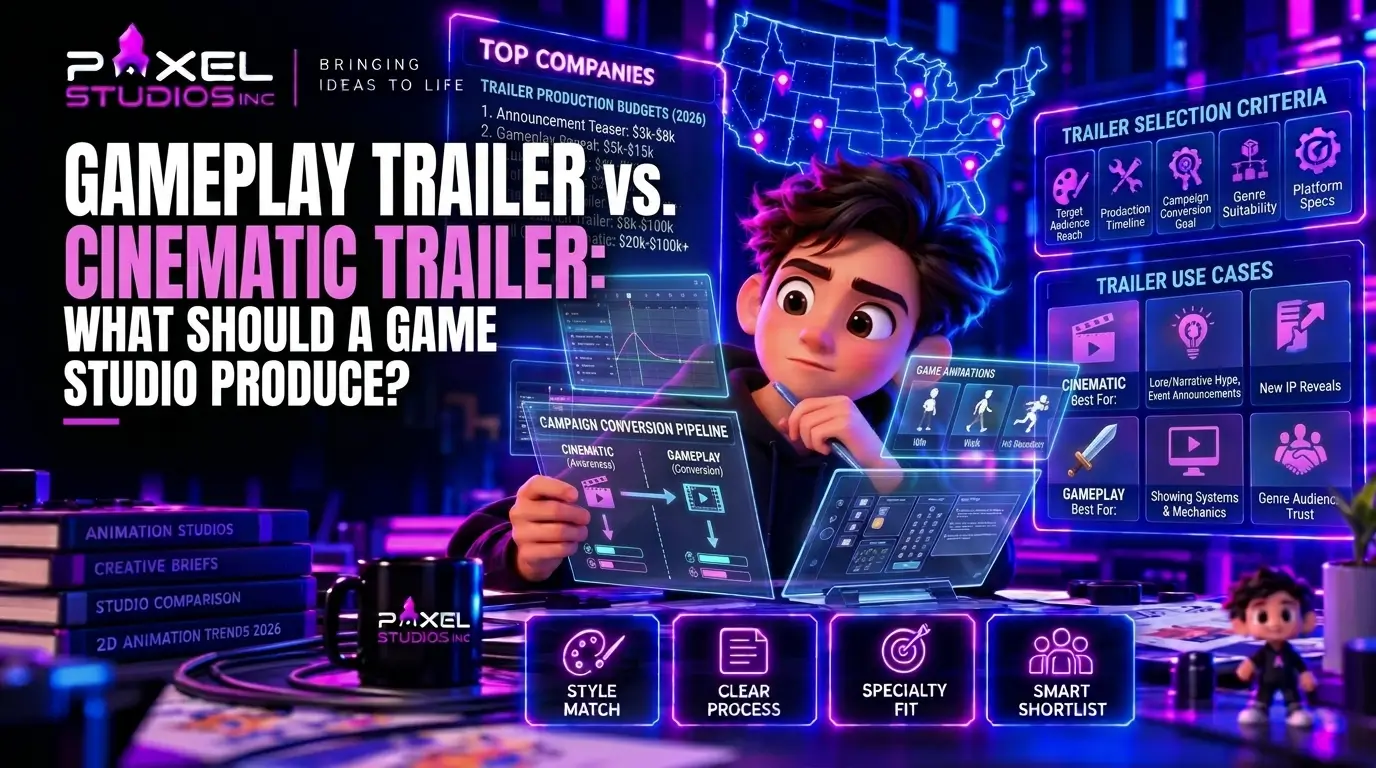
A gameplay reveal runs $5,000 to $15,000 across three to five weeks. A full CGI cinematic runs $20,000 to $100,000 and up across six to twelve weeks. Published 2026 production ranges settle the gameplay trailer vs. cinematic trailer argument for most studios before anyone discusses creative. The sharper question is order, because each format does something the other cannot, at a different point in a campaign.
The One-Line Answer
Cinematics create want. Gameplay footage converts it.
A cinematic can exist before the game is playable, which makes it the only honest option for an announcement timed to an industry event. It sells world, tone, and scale. A gameplay trailer needs a build worth showing, and it answers the question a cinematic deliberately dodges: what do I do in this game?
Ship only a cinematic and you generate interest you cannot convert, then face accusations of misrepresentation at launch. Ship only gameplay and you struggle to generate interest at all, because mechanical clarity persuades people already paying attention and does almost nothing to attract people who are not.
Introduce Your Script
To The World With Our
Explainer Videos

Cost and Timeline
| Type | Length | Budget | Timeline |
| Announcement teaser | 30 to 60 sec | $3,000 to $8,000 | 2 to 3 weeks |
| Gameplay reveal | 90 to 180 sec | $5,000 to $15,000 | 3 to 5 weeks |
| Launch trailer | 60 to 120 sec | $8,000 to $25,000 | 4 to 6 weeks |
| Full CGI cinematic | Varies | $20,000 to $100,000+ | 6 to 12 weeks |
| Social cuts, three to five | 15 to 30 sec | $1,500 to $4,000 | 1 to 2 weeks |
| Event hype clip | 30 to 60 sec | $2,000 to $6,000 | 2 to 3 weeks |
Origination explains the gap. A gameplay trailer edits footage the game already makes, so the money goes on capture, editorial, sound, and finishing. A cinematic originates every frame, adding modelling, rigging, animation, lighting, rendering, and compositing on top of all of that.
Six to twelve weeks on a cinematic is not slack. It is the pipeline a short animated film demands, and the stages are set out in the guide to the game animation pipeline.
What Each Format Is Good At?
Cinematics
Use for: announcements, new IP, narrative-heavy or fantasy settings, and productions with budget to match.
A cinematic establishes a world before a single mechanic locks, which is the only way to reveal at an event while the build is nine months from presentable. It also reaches emotional registers gameplay footage cannot, because the camera, the framing, and the performance are all authored.
The exposure is expectation. A cinematic implying fidelity or tone the game never delivers creates a credibility hole that opens loudly on launch day.
Gameplay Trailers
Use for: post-reveal beats, competitive multiplayer, roguelikes, strategy, simulation, and anything whose appeal lives in its systems.
Gameplay footage buys trust. It shows mechanics, pacing, and feel. For genre audiences, this is the deciding content: a strategy player wants the interface and the decision space, not a rendered cavalry charge.
Its weakness is attention. Raw footage rarely stops a scroll, which is why good gameplay trailers steal cinematic technique: deliberate pacing, a music build, cutting on the beat, and a graphics layer carrying context.
The Campaign Order That Works
Most effective game marketing runs both in sequence.
- Announcement. Cinematic or short teaser, timed to an event. Job: awareness and wishlists.
- Gameplay reveal. Once a build can carry it, a longer honest look at mechanics. Job: turning curiosity into intent.
- Feature trailers. Short pieces, one system or class or mode each. Job: holding interest through the pre-launch months.
- Launch trailer. Hybrid, cinematic framing wrapped around real gameplay. Job: turning intent into purchase.
- Post-launch. Social cuts, update trailers, event clips. Job: staying visible.
A studio with one budget and one shot is almost always better served by a strong gameplay reveal than a thin cinematic. A cheap cinematic reads as cheap in a category where players compare against AAA output daily. A gameplay trailer with sharp editorial and real sound design competes on ground where craft, not render hours, decides.
What Goes Into Game Trailer Production?
Game trailer production splits into two builds, and the labour sits in different places.
A gameplay-led trailer is a capture and editorial job rather than a video game animation job. The heavy lift is clean footage: a stable build, a capture rig producing usable frames, a player skilled enough to perform the exact moment the edit needs, and usually six takes of the same encounter. Editorial, sound, music, and graphics do the persuading.
A cinematic is an animation production. Modelling, rigging, 3D character animation, camera work, lighting, rendering, compositing. Cinematic animation at trailer scale needs the same disciplines a game’s own cutscenes need, which is why studios often commission both from one partner.
Sound Carries More Than Studios Budget For
Music drives pacing. Impacts sell the combat. A designed sound bed makes captured gameplay feel considerably more expensive than it was. A gameplay trailer with strong sound and ordinary visuals outperforms the reverse more often than anyone expects, and sound is the first line cut when budgets tighten.
The Graphics Layer
Titles, platform logos, release date, review pull-quotes, feature callouts. All of it built per aspect ratio. A game marketing video running on YouTube, Steam, and vertical social needs that layer rebuilt for each frame shape, because a title safe in 16:9 sits badly at 9:16.
Get On The Journey To Create The Next Hit With Us
Okay, so now, you already know that your Chromebook can easily help you in creating animations. It’s time to know how to run animation apps on Chromebook. The main thing about ChromeOS is that it plays smoothly with different platforms, like Android, web-based tools, and even Linux. This means if you want to create 2D motion graphics, want to create a 3D Vtuber model, or even animate complete scenes, there’s always a way to make it true.
Where to Source It?
In-house. Works where a studio already has editorial and motion graphics people. Cheapest for routine cuts and updating trailers, and it falls over on cinematics, which demand a full animation pipeline.
A trailer specialist. Studios whose whole business is game marketing video. Strong on structure, pacing, and storefront convention, and dependent on the developer for capture.
An animation studio. The route when cinematic work is in scope, since one team can produce in-engine or pre-rendered sequences and also handle game animation services for the game itself. Unreal Engine animation capability matters specifically here, because in-engine cinematic shots built from shipping assets avoid the fidelity jump a pre-render creates.
Whichever route, name the capture owner in the brief. A large share of trailer overruns trace to nobody owning the footage: the vendor waiting on the developer, the developer assuming the vendor would capture.
The Hybrid Launch Trailer
Launch is where the two formats fuse, and it is the most commonly fumbled piece in a campaign.
What works: cinematic framing and pacing applied to real gameplay. An authored opening beat, a music structure that builds, in-engine cinematic shots cut against gameplay, and a graphics layer carrying title, date, and platforms.
What fails: alternating rendered sequences with raw gameplay so the fidelity gap becomes the subject. If the cinematic material looks substantially better than the game, cutting them side by side advertises the difference to everyone watching.
In-engine cinematics solve it. Render story shots from game assets, and the fidelity stays level, and modern engine rendering now clears a bar that used to require a pre-render. The trade-offs are covered in the pillar guide to game animation.
Reusing the Expensive Part
A cinematic costs enough that its second life should be planned before it is commissioned. Shots often carry into the game as an opening or a chapter card, which converts a marketing line into a production asset.
That only works when the cinematic is built to the game’s own standards. Video game animation produced for a trailer in isolation, at a different scale or with assets absent from the build, cannot be dropped into game cinematics afterwards. Brief it as dual-purpose from the start,t and the economics shift, particularly where one partner handles both game animation services and marketing work.
It runs in reverse too. Existing game cinematics are re-cut into trailer material, and 3D character animation already built for gameplay carries a feature trailer with no new origination. Studios with a strong in-engine pipeline and real Unreal Engine animation capability extract the most here, because their cinematic and gameplay assets are the same assets.
Platform and Genre Change the Answer
The gameplay trailer vs cinematic trailer split moves with where the game sells.
Mobile leans gameplay, and leans short. Store listing videos get seconds of attention, and user acquisition creative is tested at fifteen and thirty seconds against dozens of variants. A single expensive cinematic has nowhere useful to run.
PC and Steam reward gameplay clarity. Steam shoppers watch for mechanics and read the tags, and a cinematic with no gameplay often reads as evasive on that storefront.
Console and event-led campaigns reward cinematics, because the announcement happens on a stage in front of an audience primed for spectacle.
Genre pushes the same way. Narrative adventures and fantasy RPGs justify cinematic spend. Strategy, simulation, and anything systems-led converts on footage.
Storefront Specs
Trailers deliver as a matrix, and the destinations set the rules.
| Destination | Spec |
| Archive master | 4K at 3840 x 2160, H.264 or ProRes |
| YouTube | 1080p or 4K, H.264, 16:9 |
| Steam | 1080p, H.264 |
| TikTok and Reels | 9:16 vertical at 1080 x 1920 |
| X | 1080p, H.264, under 2 minutes 20 seconds |
Ask for every format at the end of production. Going back for versions later turns each one into its own job. The length logic per placement is covered in the guide to animated ad length, and the versioning economics in the guide to video repurposing services.
Five Phases, Four to Six Weeks
Briefing at three to five days. Asset capture at one to two weeks. Rough cut at three to five days. Fine cut at four to seven days. Delivery at one to two days.
Capture is the phase studios underestimate. Trailer-grade footage needs a stable build, a capture setup that produces clean frames, and a player good enough to hit the beat the edit wants. Footage grabbed casually during development almost never cuts well.
Seven Mistakes
- Leading with a cinematic the game cannot match. Credibility bill arrives at launch.
- Gameplay with no editorial craft. Honest and unwatchable.
- One trailer for every placement. A 180-second reveal does not work as a vertical cut.
- Casual capture. Trailer footage is a planned shoot, not a screen grab.
- Underfunding sound. It carries more impact than the visuals in most trailers.
- Ordering versions after delivery. Each becomes a separate job at a separate price.
- Hiding the genre. A trailer that conceals what kind of game this is attracts the wrong audience and converts none of it.
Deciding
Three facts settle the gameplay trailer vs cinematic trailer question. Is there a build worth showing, because without one the cinematic is your only move. Does the appeal live in the world or in the systems, because the first favors cinematic and the second favors gameplay. And how big is the whole marketing budget, because a thin cinematic loses to a well-made gameplay piece every time.
For most studios below AAA scale: short teaser to announce, strong gameplay reveal to convert, feature cuts to sustain, hybrid launch trailer borrowing cinematic animation craft without originating a full CGI short. Answering gameplay trailer vs cinematic trailer that way keeps the money on the piece that sells copies.
Pixel Studios Inc. produces gameplay-led and fully cinematic game trailers with the delivery matrix scoped at brief stage, drawing on its game trailer, titles and trailer animation, and entertainment animation work.
Introduce Your Script
To The World With Our
Explainer Videos
Frequently Asked Question?
Which comes first, cinematic or gameplay?
A cinematic or short teaser, usually, since it can be made before the game is playable and suits an event-timed announcement. The gameplay trailer follows once a build can carry it, because its job is converting the interest the announcement created.
How much does a cinematic trailer cost against a gameplay one?
Published 2026 ranges put a gameplay reveal at $5,000 to $15,000 and a full CGI cinematic at $20,000 to $100,000 or more. A cinematic originates every frame, while a gameplay trailer edits footage the game already produces.
How long should a game trailer be?
Announcement teasers run 30 to 60 seconds, gameplay reveals 90 to 180, launch trailers 60 to 120, and social cuts 15 to 30. Each destination also imposes its own resolution and aspect ratio.
Can one trailer mix cinematic and gameplay footage?
Yes, and launch trailers routinely do. The danger is cutting rendered material against gameplay so the fidelity gap becomes the story, which is why in-engine cinematic shots built from shipping assets work better than pre-rendered sequences in hybrids.
Which formats should be requested upfront?
A 4K archive master, 1080p or 4K H.264 for YouTube, 1080p for Steam, 9:16 at 1080 x 1920 for TikTok and Reels, and a cut under two minutes twenty for X. Asking at the end of production stops each one from becoming a separate job.

