
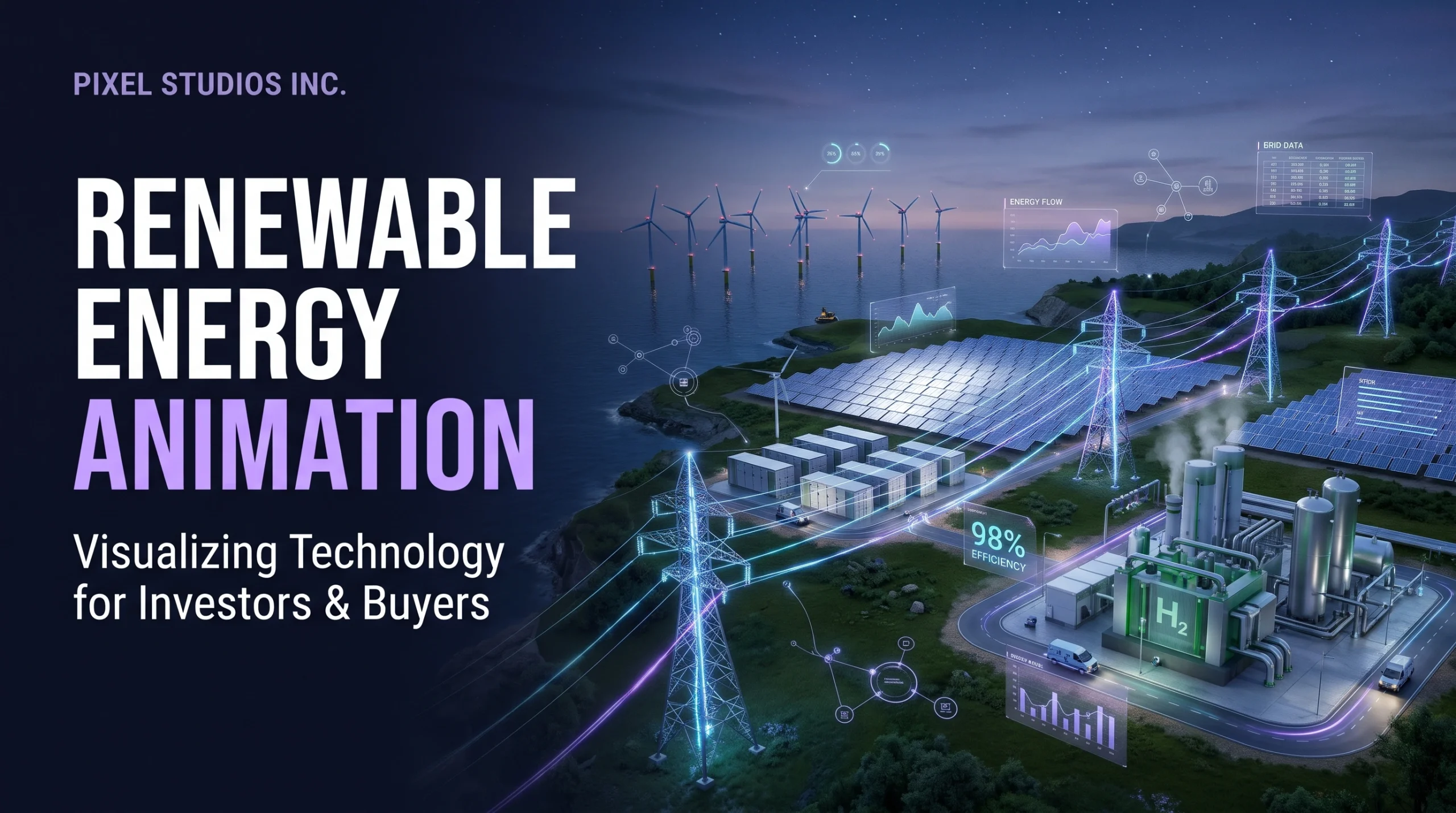
Show the physics, the project, and the return before anyone asks for the spreadsheet. The IEA expected $2.2 trillion to flow into clean energy and grids, roughly double the amount going to fossil fuels. Capital is available. The competition for it is brutal, and most of what clean energy companies sell can’t be seen: electrons moving through a grid, heat rising from three kilometers underground, hydrogen splitting from water. Renewable energy animation makes that work visible to the people who fund it, buy from it, and approve it. Here is how to build it for each of those audiences.
The Money Is There. The Attention Isn’t.
Of the IEA’s $3.3 trillion global energy investment estimate for 2025, around $780 billion was headed for renewable power, mostly solar and wind. That figure hides how hard it is for any single project to reach financial close.
In the United States, the grid connection queue tells the story. Berkeley Lab data reported by the American Public Power Association shows 2,061 GW of generation and storage waiting in interconnection queues at the end of the quarter. Of the capacity that entered queues between 2000 and 2020, only 13% had reached commercial operation, and 75% had withdrawn.
Most projects never get built. The ones that do usually have strong economics, patient developers, and the ability to explain themselves quickly to people with limited time: credit committees, utility procurement teams, corporate sustainability leads, planning boards, and the residents who show up to public hearings. Clean energy animation is one of the most efficient tools for that last job. It compresses a technical case into something a non-engineer can follow in two minutes.
Introduce Your Script
To The World With Our
Explainer Videos

Investors and Buyers Ask Different Questions
A renewable energy company usually speaks to two groups at once. Investors want to know if the asset will return capital. Buyers, from utilities and corporate offtakers to homeowners, want to know if it will deliver reliable power at a fair price. The same technology needs two different stories.
| The question | How an investor asks it | How a buyer asks it |
| Does it work? | “What’s the technology risk, and has it been proven at scale?” | “Will it produce what you promise, every day?” |
| What does it cost? | “What’s the LCOE, capex, and payback period?” | “What will I pay per megawatt-hour, and for how long?” |
| What could go wrong? | “Curtailment, grid delays, supply chain, policy shifts?” | “What happens on a windless night or a cloudy week?” |
| Why you? | “Why does this team and this site outperform?” | “Why choose your project over the next proposal?” |
| What’s next? | “How does this scale to a portfolio?” | “Can this grow with our demand?” |
Most energy marketing, including a lot of renewable energy animation, tries to answer both columns in one film and ends up too technical for buyers and too thin for investors. Plan a shared visual world, then cut separate versions. The turbine model, the site terrain, and the grid diagram can appear in both; the narration, data, and closing ask should change.
What to Show for Each Technology
Every clean energy technology has a part that people can’t picture. That part is where renewable energy animation earns its budget.
Wind: Scale, Wake, and Installation
Modern offshore turbine blades exceed 100 meters, longer than the wingspan of the largest passenger jets, and that scale is hard to grasp from a spec sheet. Wind energy animation can place a turbine next to a familiar landmark, then pull out to show how a full array is spaced to limit wake losses between rows. For offshore projects, it can show the installation sequence that investors worry about most: monopile driving, jack-up vessel positioning, blade lifts in a weather window. Floating foundations in deep water are almost impossible to explain any other way.
Solar and Storage: Time, Not Panels
Solar panels photograph easily, so the hard part is everything panels don’t show. Tracker systems follow the sun across the day. Bifacial modules collect reflected light from the ground. A battery charges at noon and dispatches into the evening peak. Animation can compress 24 hours into 20 seconds and show the generation curve and battery dispatch rising and falling together, which is the whole economic case for a hybrid project in one shot.
Green Hydrogen: Molecules and Systems
Electrolysis happens at a scale nobody can see. A clear animation zooms from the full plant down into the electrolyzer stack, shows water splitting at the membrane, then pulls back out to compression, storage, and the end user: a steel mill, a fertilizer plant, a refueling station. Investors in hydrogen projects need to understand the whole value chain, and a single film can walk them through it.
Geothermal: What Lies Below
Geothermal is the clearest case for animation in the sector, because the asset is underground. Cutaways show wells reaching hot rock, fluid circulating through fractures, and heat returning to a surface plant. Next-generation enhanced geothermal systems, which borrow drilling techniques from oil and gas, are especially hard to explain without moving visuals.
Grids, Transmission, and Virtual Power Plants
A virtual power plant links thousands of home batteries, EV chargers, and smart thermostats into one dispatchable resource. On paper, it’s a software diagram. In animation, it’s a neighborhood lighting up as homes respond to a grid signal together. Transmission and grid-scale storage companies use the same approach to show how their assets relieve congestion.
Making Invisible Physics Watchable
Energy is flow, and flow needs visual rules. Set them once and use them in every video.
- A color code for energy types. One color for electricity, another for heat, another for hydrogen or fluid. Keep them consistent across every scene.
- Direction and speed carry meaning. Faster particle movement means higher output. Reversed flow means charging versus discharging.
- Time compression with on-screen clocks. When a day passes in twenty seconds, show the clock so viewers know what they’re watching.
- Scale references. Put a person, a truck, or a house next to a turbine or electrolyzer the first time it appears.
- Data layered on the scene. Output figures, capacity factors, and avoided emissions appear as clean overlays tied to what is happening on screen. This approach to animated data visualization keeps numbers readable without stopping the story.
These conventions are what turn a beautiful render into a working animation explainer video, and they are what investors remember after the meeting ends. Without them, viewers admire the turbine and miss the point.
The Investor Film and the Buyer Film, Side by Side
The two versions share assets and differ in almost everything else.
| Element | Investor film | Buyer film |
| Length | 2 to 3 minutes | 60 to 90 seconds |
| Opening | Market size and the gap the project fills | The buyer’s problem: cost, reliability, emissions targets |
| Technology depth | High: how it works, risk mitigation, proven components | Moderate: what it does and why it’s dependable |
| Data shown | Capacity, capex, LCOE range, timeline, pipeline | Price stability, supply profile, emissions avoided |
| Tone | Measured, evidence-led | Clear, reassuring, practical |
| Closing ask | Meeting, data room access | Proposal request, site visit, PPA discussion |
Investor films usually live inside pitch decks and data rooms. Buyer films go on websites, into sales proposals, and onto screens at events such as RE+, WindEurope, and the World Future Energy Summit.
Permitting and Community Engagement
Many renewable projects stall at the local level, where residents worry about views, noise, wildlife, and property values. Animation helps here, provided it is honest.·
- Viewpoint simulations. Show the project from the actual places people care about: the town square, the beach, the ridge trail. Use real terrain data and correct turbine heights.
- Construction sequencing. Show how long works will take, where trucks will travel, and how the land will be restored.
- Environmental measures. Show bird and bat monitoring systems, setbacks from homes, and habitat protection areas.
- Community benefit. Show where the revenue goes: local jobs, tax contributions, community funds.
Planning authorities and public agencies increasingly expect this kind of material at consultations, and our government animation work shows how to present it in a format suited to public meetings. Accuracy here is critical. A simulation that makes turbines look smaller than they will be can damage trust for the developer’s entire pipeline.
A Worked Example: 90 Seconds for a Solar-Plus-Storage Project
Here is how an investor-facing renewable energy animation for a 200 MW solar farm with a four-hour battery might be storyboarded. The structure carries over to wind, hydrogen, and geothermal with different scenes.
| Time | Scene | What it shows |
| 0:00–0:12 | Regional grid at evening peak | Demand rising as solar output drops, price spikes on overlay |
| 0:12–0:25 | Aerial reveal of the site | Terrain, substation, transmission line, distance to load center |
| 0:25–0:40 | Single-axis trackers through a compressed day | Panels following the sun, generation curve building on screen |
| 0:40–0:55 | Battery yard cutaway | Charging at midday, discharging into the evening peak |
| 0:55–1:10 | Revenue stack overlay | Energy sales, capacity payments, ancillary services |
| 1:10–1:22 | Timeline and milestones | Permits secured, interconnection status, construction start |
| 1:22–1:30 | Close | Team, portfolio pipeline, call to action |
The film answers the four questions a credit committee asks first: where is the site, how does it make money, what reduces risk, and when does it come online. Every scene supports one of those answers.
Why 3D Carries Most Energy Stories?
Renewable energy 3D animation is the natural fit for the sector because most of the assets are large, physical, and engineered from CAD data. Turbine nacelles, electrolyzer stacks, battery containers, and inverter stations can be modeled from manufacturer drawings and shown accurately from any angle. Teams that already hold engineering files can follow the approach in our guide on turning CAD files into 3D animation, and our 3D animation services cover the full pipeline from model to final film.
Equipment manufacturers selling turbines, trackers, or electrolyzers have a further need: showing internal mechanics to engineering buyers. Our 3D industrial animation service focuses on that level of mechanical detail, and the manufacturing animation page covers how the same models feed sales and training.
2D still has a role. Policy explainers, financing structures, and residential solar sales often work better as flat illustration and motion graphics, which are faster to produce and easier to update when incentives change. Many energy companies use 3D for the asset and 2D for the business model, inside the same video.
Three Objections Energy Executives Raise
These are the pushbacks clean energy teams hear most often when proposing an animation budget, with straight answers.
“Our Investors Only Care About the Financial Model”
The model decides the deal. Animation decides how quickly an investment committee understands what the model describes. A partner who grasps the site, the technology, and the revenue stack in two minutes reads your financials with fewer questions and more confidence. Treat the film as the cover page of the data room.
“Animation Will Look Like Greenwashing”
It will if it shows wildflowers, rainbows, and smiling families with no data. Credibility comes from accuracy: correct equipment dimensions, real terrain, honest capacity factors, and clear labels on any projections. Clean energy animation built on engineering data reads as evidence. Animation built on stock imagery reads as advertising.
“Our Technology Changes Too Fast”
Energy technology does move quickly, and that’s an argument for animation over live footage. A 3D model can be updated when a component changes, and individual scenes can be re-rendered without reshooting anything. Plan the film in modular scenes from the start, and a technology update becomes an edit instead of a new production.
Getting More From One Model
The most expensive part of renewable energy 3D animation is building the first accurate model of the site and its equipment. Once it exists, every new asset costs far less, so plan the whole year’s content around it.
- Quarterly investor updates. Re-render the site with construction progress, then overlay milestones as they are reached.
- Procurement proposals. Drop the buyer film into every PPA response, with a custom end card for each off-taker.
- Recruitment. Technicians and engineers want to see the sites they will work on. A 30-second cut of the facility tour helps fill hard-to-hire roles.
- Short social clips. Turbine blade lifts, battery dispatch loops, and electrolyzer close-ups make strong 10 to 15-second posts.
- Each new project. Turbines, trackers, and battery containers carry over from one site to the next, so the second project film costs much less than the first.
A single animation explainer video planned this way becomes the start of a content library. Teams that treat renewable energy animation as a one-off launch asset usually end up commissioning the same model twice.
Six Decisions to Make Before Production
- Pick the primary audience. Investor, offtaker, residential customer, or community. Choose one for the master film.
- Choose the technology moment. The one thing about your system that people can’t picture without help.
- Set your visual rules. Colors for energy types, scale references, and how time compression will be signaled.
- Gather engineering data. CAD files, site terrain, equipment specs, and performance figures.
- Agree on what can be shown. Confirm which financial figures, partner names, and site details are cleared for public use.
- List the cutdowns. Investor version, buyer version, social clips, event loop, and consultation version.
Length, scene count, and realism drive budget. This guide to 3D animation cost breaks down how each factor affects price, so you can scope a master film and its versions together.
Bring Your Technology Into View
Your project’s strongest argument may be the part nobody can see. Pixel Studios Inc. builds renewable energy animation that shows the physics, the site, and the economics in a way investors, buyers, and communities can follow, built from your engineering data and cut for every audience you need to reach. Explore our 3D animation services to see the formats we produce for energy and infrastructure companies.
When you’re preparing for a raise, a procurement round, or a public consultation, book a free project consultation. Bring the one part of your technology that’s hardest to explain, and we’ll show you how to make it clear.
Introduce Your Script
To The World With Our
Explainer Videos
Frequently Asked Question?
What is renewable energy animation?
Renewable energy animation is 3D or 2D video that explains how clean energy technologies and projects work, including wind farms, solar and storage plants, hydrogen systems, geothermal wells, and grid infrastructure. It shows processes that cameras can’t capture, such as energy flow, subsurface heat, or a full day of generation, for investors, buyers, and communities.
How does wind energy animation help offshore projects?
Wind energy animation shows the scale of modern turbines, how arrays are spaced to limit wake losses, and how foundations, cables, and turbines are installed at sea. For floating offshore wind, it explains mooring systems and platform behavior in deep water, which is difficult to communicate with drawings or photos.
Should renewable energy companies use 2D or 3D animation?
Most use both. Renewable energy 3D animation suits physical assets such as turbines, panels, batteries, and electrolyzers, especially when CAD data exists. 2D illustration and motion graphics suit financing models, policy explainers, and residential sales, where clarity and fast updates matter more than physical realism.
How long should a clean energy animation be?
Investor films typically run two to three minutes, buyer and product films 60 to 90 seconds, and social or event loops 15 to 30 seconds. Community consultation videos vary by project but should focus on viewpoints, construction timing, and environmental measures.
What makes an animation explainer video credible to energy investors?
Accuracy and restraint. Use correct equipment dimensions, real site terrain, realistic performance data, and clear labels for any projections or illustrative figures. Investors trust films that show risk mitigation and timelines as clearly as they show the technology itself.

